
If your baby’s skin gets red easily, reacts to new products, or seems dry no matter what you try — you’re not imagining it.
Baby skin is biologically different from adult skin.
And once you understand why, caring for it becomes much simpler.
Let’s break it down in plain terms.
Why Baby Skin Is More Sensitive
1. The Skin Barrier Is Still Developing
Think of skin like a brick wall.
In adults, that wall is strong and tightly sealed.
In babies, it’s still under construction.
That means:
-
Moisture escapes faster
-
Irritants can enter more easily
-
Skin reacts more quickly
By about age 2, the barrier becomes much more “adult-like.” But in the first year? It’s still learning.
2. Babies Lose Water Through Their Skin Faster
There’s a scientific term for this: transepidermal water loss (TEWL).
All you need to know is this:
Baby skin dries out faster.
Which is why dryness, flaking, and rough patches are common.
3. Skin pH Is Still Adjusting
Adult skin is slightly acidic — that acidity helps protect it.
Newborn skin starts closer to neutral and gradually becomes more acidic in the first weeks of life.
During that transition, skin can be more reactive.
4. The Microbiome Is Still Forming
Your baby’s skin is building its own ecosystem of healthy bacteria.
Until it stabilizes, reactions and sensitivity are more common.
How Common Is Eczema?
Very common.
Recent data shows about 12–13% of U.S. children have diagnosed eczema.
Some pediatric sources describe it as affecting up to 1 in 4 children at some point.
Eczema isn’t unusual. It’s often the combination of:
-
Genetic tendency (family history of allergies, asthma, eczema)
-
Environmental triggers
-
A naturally vulnerable skin barrier
What “Sensitive Skin” Often Really Means
In babies, sensitive skin is often one of these:
-
Eczema (dry, red, itchy patches)
-
Irritant contact dermatitis (reaction to wipes, soap, saliva, friction)
-
Allergic contact dermatitis (reaction to specific ingredients like fragrance or preservatives)
Common triggers include:
-
Fragrance (including “natural fragrance”)
-
Essential oils
-
Harsh cleansers
-
Bubble bath
-
Certain wipe preservatives
-
Rough fabrics
-
Detergent residue
The Simplest Strategy That Works: Barrier-First Care
Instead of constantly changing products, focus on protecting the skin barrier.
Here’s what that looks like.
The Easy Daily Routine
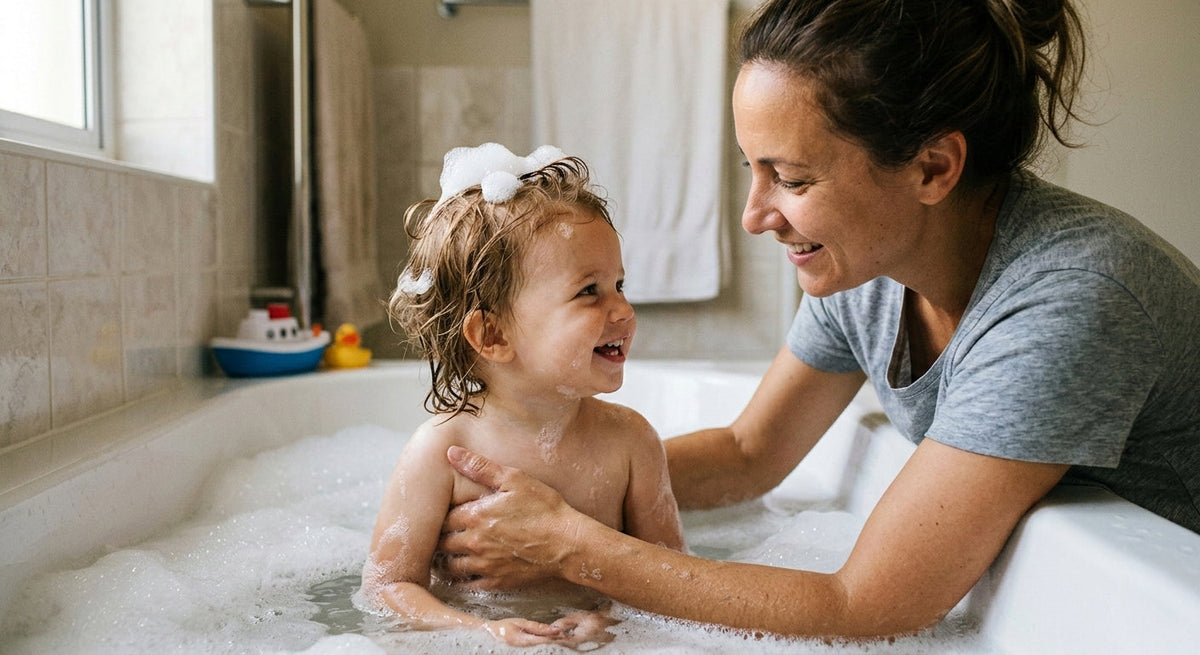
Step 1: Short, Lukewarm Baths
-
Keep baths 5–10 minutes
-
Use lukewarm water (not hot)
-
Use gentle cleanser only where needed
-
Skip bubble baths
You don’t need daily baths for babies. 2–3 times per week is often enough unless very messy.
Step 2: “Soak and Seal”
This is key.
Immediately after the bath:
-
Pat skin dry (don’t rub)
-
Apply a thick, fragrance-free moisturizer
Moisture needs to be sealed in while skin is still slightly damp.
Creams or ointments usually work better than thin lotions for very dry skin.
Step 3: Spot Care During the Day
Check “hot spots” like:
-
Cheeks (drool irritation)
-
Neck folds
-
Diaper area
Use barrier ointment where friction or moisture is constant.
Keep nails trimmed to reduce scratching damage.
When Eczema Flares
If you see:
-
Red, itchy patches
-
Rough areas that don’t improve with moisturizer
-
Recurring spots in the same areas
It may be eczema.
Most pediatric guidelines recommend:
-
Short baths
-
Immediate moisturizing
-
Early treatment of inflammation
-
Use of topical steroids when prescribed
Topical steroids are often misunderstood — when used correctly and under guidance, they are considered safe and effective.
If patches are:
-
Oozing
-
Crusting
-
Very painful
-
Spreading quickly
Call your pediatrician.
Ingredient Red Flags to Watch For
When shopping for baby products, look past marketing words.
“Hypoallergenic” is not a guarantee.
Instead:
Avoid:
-
Fragrance / parfum
-
Essential oils
-
Methylisothiazolinone (often in wipes)
-
Harsh detergents (like SLS)
-
Products with very long ingredient lists
Look for:
-
Fragrance-free (not just unscented)
-
Short ingredient lists
-
Simple formulations
-
Creams/ointments over lightweight lotions
Sometimes fewer products — not more — makes the biggest difference.
Common Baby Skin Issues (And First Steps)
Cradle Cap
Greasy scalp scales.
Try:
-
Gentle shampoo
-
Soft brush
-
Light oil to soften scales before washing
Diaper Rash
Often caused by moisture and friction.
Help by:
-
Frequent changes
-
Zinc oxide barrier cream
-
Fragrance-free wipes or water only
If rash is bright red and in skin folds, yeast may be involved — contact your pediatrician if it doesn’t improve.
Heat Rash
Tiny red bumps in warm weather.
Cool the skin and use breathable fabrics.
When to Seek Medical Care
Call urgently if:
-
Baby under 3 months has a fever
-
Rash is rapidly spreading
-
Skin is oozing or crusting
-
Baby seems very ill
Schedule a visit if:
-
Rash doesn’t improve after several days of good home care
-
Diaper rash persists
-
You suspect a product allergy
The Big Takeaway
Your baby’s skin isn’t “overreacting.”
It’s developing.
Because the barrier is thinner, moisture escapes faster, and the microbiome is still forming — sensitivity is normal.
The goal isn’t perfect skin.
It’s supported skin.
Keep it simple.
Protect the barrier.
Moisturize consistently.
Reduce unnecessary exposures.
And when in doubt, involve your pediatrician.